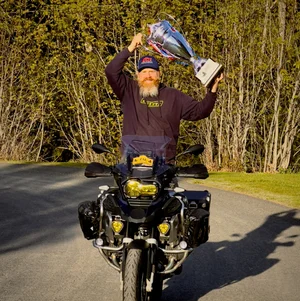
Windsor Studio — Episode
Lois Pryce on Iran, Curiosity, and the Road Fewer People Take
Go and Wake Up Your Luck

Lois Pryce with Taylor Lawson and Aaron Pufal — Windsor Studio, 2026
Standing in an immigration queue at the Iranian border, nervous, conspicuous, and convinced she was about to be arrested, Lois Pryce watched an older Iranian woman in a black chador catch her eye and begin making motorcycle revving gestures with her hands. Through a translator, the message came through: go, go, go. And then a phrase in Persian that Pryce has carried with her ever since.
"Go and wake up your luck."
It was the moment she understood that Iran was a completely different country than the one she had been imagining her whole life. Pryce is the author of three books about long-distance solo motorcycle travel. The most recent, Revolutionary Ride, chronicles two journeys through Iran at a time when the British embassy in Tehran had been shuttered and relations between the two countries had hit one of their periodic lows. In this episode, Taylor Lawson and Aaron Pufal sit down with her at the Windsor Studio for a conversation about fear, the politics of perception, and why the first word that comes to mind when she thinks of Iran is "fun."
The Politics of Being There
Revolutionary Ride grew out of a note Pryce found on her motorcycle in London, left by an Iranian man who had seen her bike parked near the embassy. Had she ever been to Iran? It was a beautiful country. And then, in capital letters: "WE ARE NOT TERRORISTS."
She had not been. She considered herself open-minded and curious. And yet the idea felt vaguely scary, and she recognized that for what it was. "If I was afraid of going to Iran," she says, "that really is just ignorance. And so in that case, I should go and find out about it."
The experience changed her at what she calls a cellular level. The Revolutionary Guard, she notes, run not just the security apparatus but also, quietly, much of the smuggling trade in alcohol and satellite dishes. Everything officially forbidden finds a way to persist. Iranians love to party. She could not keep up. The book that resulted is less about her than about Iran, by design. "Iran," she says, "is more interesting than me."
She felt a duty to put that into print, but without preaching. Her books reach what she calls regular people, readers who come for a good time and might leave knowing something they did not expect. Everywhere she went, people pulled her aside to say some version of the same thing: please tell people we are not what they think. One reader later wrote to say the book had made him a better person. "I thought," she says, "okay, I can die happy now."
On whether that conviction still holds in 2026 with the Iran war ongoing, she is honest: she still believes the reality on the ground is always different from the headlines, but the risk of traveling there is higher than it has ever been. She points to Craig and Lindsay Foreman, a British couple who entered Iran from Armenia in late December 2024 on a round-the-world motorcycle trip, were arrested on espionage charges on January 4, 2025, and were sentenced by Tehran's Revolutionary Court to ten years in Evin Prison in February 2026. Their appeal was denied in June 2026. She would not condemn anyone for going, but she would urge genuine caution.
Freya Stark, Theresa Wallach, and the Women Who Went Anyway
The conversation turns to precedent, and Pryce is generous on the subject of her predecessors.
Freya Stark first traveled into the mountains of Iran in 1930, hunting for the ruined castles of the medieval Assassin sect. She learned Persian among several other languages, immersed herself with locals in ways the British establishment found distasteful, and was consistently dismissed by the male-dominated exploration societies of her day. She appears as what Pryce calls a "ghost" at the opening of Revolutionary Ride, a presence felt rather than a template followed.
"She traveled for fun," Pryce says. "And I love that she mixes this really deep interest with getting out there and getting her hands dirty and enjoying herself at the same time."
She also mentions Theresa Wallach and Florence Blenkiron, who in 1934 rode a motorcycle with a sidecar from London to Cape Town across the Sahara, an achievement that generated mostly laughter from those who heard about it in advance. Pryce made a version of the same journey for her second book. The common thread across all of them, she suggests, is not simply that they went, but that they went in defiance of what the world had decided was reasonable.
Being a woman traveling alone, she notes, has its specific advantages. Families invite you in. Women share spaces with you that men cannot enter. And you are never read as a threat. "Because you're a woman and you're by yourself, you're just not a threat," she says. "So you tend to be able to see a lot of the world that a man might not be able to."
What She Carries Home
Near the end of the conversation, Pryce mentions the Omidvar brothers, two Iranian explorers who rode British motorcycles around the world from 1954 to 1964 and painted a message on their front mudguards that they carried into every country they passed through. In Persian and English, it read: "All different, all relative."
That, for Pryce, is the philosophy. The difference is the point, and curiosity is what gets you there. If it outweighs the fear, she says, the world tends to have something waiting for you.
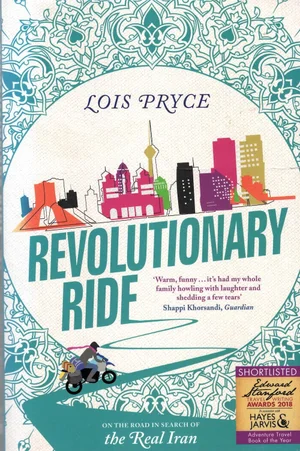
Revolutionary Ride
Revolutionary Ride is the current selection in Aaron's Motorcycle Book Club. If this conversation has you reaching for it, that is the place to join the discussion.
Join the Motorcycle Book ClubNew Episode — Windsor Studio
Listen to the full conversation on Spotify →