NEW BOOK

You Are Family
A Yacht Captain, a Fixer, and a CIA Asset Inside the World of the Ultra Rich
Target release: spring 2027.
FOR IMMEDIATE RELEASE September 9, 2026
Award-Winning Author Aaron Pufal Announces You Are Family, a Follow-Up to Chasing Legends
His first book gave his own life one hurried chapter. Readers came back asking what was behind every door he had walked past: twenty-five years as a yacht captain, estate manager, and fixer for billionaires and royalty, a coercive recruitment inside the American embassy in Abu Dhabi, and the family money behind an Iowa governor candidate's everyman image.
Aaron Pufal, author of the award-winning non-fiction book Chasing Legends: Motorcycle Stories from the Podcast Trail, has announced his second book, You Are Family: A Yacht Captain, a Fixer, and a CIA Asset Inside the World of the Ultra Rich, a full-length memoir due in 2027.
The first book chased other people's legends. This one was not his idea. Readers and podcast listeners kept coming back to the one hurried chapter about his own life, asking who those people were, what the agency thing was, and what he was still not saying. So he stopped arguing and started writing.
The result has every trappings of a tell-all: sex, drugs, money, crime, spies, politicians, and the names attached. That is not what the reader is left with. What stays is a question about what loyalty is worth when only one side is ever asked to pay for it.
Why now
Pufal offers three reasons, and he is blunt about all of them.
The first is arithmetic. "There are more days behind me than ahead of me," Pufal said. "Everybody in this book is counting on me to die quietly or violently. I know where the bodies are buried, because I am the one who buried them."
The second is Iowa. Pufal spent fourteen years working for the family of Nixon Lauridsen, whose daughter Christine is married to Rob Sand, Iowa's state auditor and the Democratic candidate for governor. Sand campaigns as an ordinary Iowan, and his campaign has made a point of announcing that ninety-five percent of its donations were one hundred dollars or less. A year before Sand announced, the Lauridsens had already put seven million dollars into his run, and the family total now stands at nearly twelve million, a fortune built at Lauridsen Group Incorporated. This is not a grassroots campaign built on small donors. It is a campaign seeded and funded by some of the richest people in Iowa, and the small donors came after. Pufal knew that before there was a campaign to count. Nixon Lauridsen agreed to bankroll his son-in-law's run while Pufal was still working for him, well before Sand announced, and inside the house it was no secret. The public record has since caught up with what he already knew.
Pufal spent fourteen years running the life that money paid for: the Aspen ranch that sold for eighty million dollars, the yachts and the parties aboard them, the family vacations, the private jet travel, the drugs somebody had to go out and get, the armed mercenaries somebody had to hire, and the problems that needed solving quietly. He is not guessing at any of it. He booked it, staffed it, paid for it, fetched it, armed it, and cleaned up after it. When he started saying so in public, the response arrived in stages.
"They deleted every comment I wrote, then they banned me from the campaign's page, and when that was not enough, Lauridsen sent his New York lawyers after me," Pufal said. "A comment can be deleted. An account can be banned. A book cannot. So it is all going into one document, with the receipts attached."
The third is the Middle East. Pufal captained a one hundred twenty foot tri deck for a member of the UAE royal family and says he was approached inside the United States embassy in Abu Dhabi while applying for a fiancé visa, then recruited to report on his employer and on the guests who came aboard: diplomats, ambassadors, envoys, and the people who travel with them. The handler who recruited him is dead. That is part of why this can be told now.
"I was an immigrant applying for the right to marry the woman I loved. It was not my government yet. That was the whole point. They held everything I wanted and owed me nothing," Pufal said. "I am telling it because the collection of compromising material is running rampant through yachting, and through the whole world of the ultra-rich that it serves. Sometimes it is the crew. Sometimes it is the owner. Sometimes it is the broker, the fixer, the pilot, or the man who delivers the drugs. Everybody close to that kind of money is collecting or being collected on, and most do not know which. It is the business model."
There is also a reason it took this long. Some of it had to wait for a statute of limitations to run out. The rest had to wait for Pufal to spend years preparing for every outcome of publishing this book, from a lawsuit to something worse.
"I made myself the hardest target I could be, and I made sure that if somebody got through anyway, everything was already in order," Pufal said.
Told from the inside
The memoir moves from a first job commissioning an eighty-foot yacht for a New York crime boss, through the Bahamas, Mexico City, Dubai, and Lviv, to a severance envelope worth a third of what was promised and the words “Good luck with your next project.”
One chapter covers the Baaden, an eighty-five-foot expedition yacht built for Nixon Lauridsen that capsized during its launch at Anacortes, Washington, in 2014. Pufal had managed the build, hired for a yacht meant to take Lauridsen around the world. Then Lauridsen remarried; his new wife had no interest in yachting, and the plan changed to finishing the boat and selling it. Pufal and his entire crew were let go months before the launch. The National Transportation Safety Board later found the probable cause to be a low margin of stability, caused in part by a recording error when the vessel was weighed. Pufal has a less polite word than error for a ten-million-dollar yacht being weighed wrong, and a chapter on the people who were responsible for the build after he was gone and what they stood to make on the sale. The capsize was carried by NBC News, CNBC, and Seattle television, which quoted Pufal by name. His deposition went on to win the lawsuit for Lauridsen, who was paid out in full. Pufal says his career in that part of the industry never recovered, and that nobody who profited from the outcome ever acknowledged what it cost him.
"They tell you that you are family," Pufal said. "You go to the weddings. You sit at the family dinners. You watch the children grow up. You are there for the shrieking the day the puppy arrives, and you are there for the silence years later when the same dog is put down. You hold the secrets. And you keep holding them, because the day you know too much, you stop being an employee and start being a liability. Then one day they are finished with you, and you find out exactly what family was worth."
The title comes from the first thing a New York boss said to him at twenty-something years old, standing on a yacht he had just commissioned. When you are on board, you are family. Pufal says he heard some version of that sentence from every employer that followed, in four languages and on three continents, and that it meant the same thing every time.
There is a reason the book can be this specific. The tradecraft Pufal was taught early on, how to handle documents, what to photograph, what to keep, and where to keep it, became habit long after the arrangement that taught it to him had ended. He kept it up for the next two decades without much thinking about why. The result is a memoir built on records rather than recollection.
"I did not set out to build a case against anybody. I was trained to collect, and then I never stopped collecting," Pufal said. "Twenty years later I sat down to write and discovered I had the documents, the photographs, and the messages, dated and in order. This book is not my word against theirs."
The book is also a practical handbook for the crew, staff, and security professionals who work for the very wealthy: which parts of an employer's life to stay out of, how to prepare for the day you are discarded, and how to do the job well without falling for it. Pufal wants readers to learn from his mistakes: do the work, look after your own interests, and understand that when they call you family, it is a story they tell to manipulate you, and the ending is already written.
It is also an account for national security professionals, who should understand what a superyacht is before they let a dignitary step aboard one: a floating collection platform, staffed by strangers, where every service in the world has a reason to be listening.
The rarefied air
Not all of it is an indictment. Pufal pulled five people and two dogs off a burning motor yacht off Hilton Head, a boat that had been christened Final Act, which, as it turned out, it was. He never got a thank you from any of them. He rescued a party of stranded Mexican VIPs off Belize on a pair of jet skis, one of which sank under him, and was rewarded with a shot of tequila and a week of pneumonia. There was coffee in the lobby of the Burj with a man who was not who his business card said he was, and whisky on the aft deck with the kind of men who get the call when the job requires a bone saw, motorcycles across the dunes of Oman, a hundred and twenty-foot tri-deck run at thirty knots through the Strait of Hormuz, and a cannon fired beside the yacht on Dubai Creek with the prime minister of South Korea aboard. There were also nights no gossip column will ever print, at parties the famous do not get invited to, thrown by people with no need to be seen. All of it is in the book, because all of it was the job.
None of which Pufal was remotely qualified for. He grew up in a house run by alcoholics and left it early, with no formal education, no money, no manners, and nobody who had ever shown him how anything worked. He is still not entirely sure how a kid with that resume ended up at the helm of a superyacht, and he suspects nobody ever checked.
They trusted him with a war
By 2022, Pufal had been with the Lauridsens for twelve years, and the relationship had stopped resembling employment. They had also seen what he did in a crisis. When Hurricane Matthew hit the Bahamas in 2016, he loaded his single-engine airplane with medical supplies and piloted it in, the first relief to reach the hardest-hit islands, with Nix Lauridsen contributing to the cost. So when the invasion of Ukraine began, the family came to him and asked what could be done immediately. They knew precisely what his background was, and they gave him a budget. What he did with it was his own decision.
He went in credentialed as an employee of a Polish security company, and started by running supplies toward the front: medical kit, body armor, communications gear, and cash, at a point in the war when trauma supplies were almost impossible to get. Getting into the country meant reading the situation and exploiting it: he identified a convoy of tractor-trailers loaded in Poland, moving under Polish diplomatic escort and consigned to the Polish embassy in Lviv, and attached himself to it as the surest way across the border. Only later did he work out what he had made himself into. Nobody targets a man carrying tourniquets. Putin's generals target tractor-trailers full of weapons.
He taught people how to use what he had brought them, drawing on his time as a volunteer firefighter and emergency medical responder in Washington state, because he knew the men he was training were going to the front. Once he was there he found he could do more. Using the tradecraft his handler had taught him in Abu Dhabi, he built a chain of contacts running through the west of the country and into Poland, and began moving people out along it. When he got home, CHEK News in Victoria, British Columbia, interviewed him about the trip.
His expenses were paid by Augie Lauridsen, Christine's brother and an executive at LGI.
That is the level of trust involved. They knew what he had been; they sent him into a war with their money and their name on it, and they did not ask for an itinerary.
And then it ended
Two years later it was over in an afternoon.
The book ends in Aspen in the spring of 2024. Pufal had spent more than a year on a property the family bought for just under forty million dollars and sold for eighty. When it closed, he was let go. There was no bonus, no commission, and no participation of any kind in the forty million dollars of profit, and the severance came to a third of what he had been told to expect.
"Fourteen years, and I made them forty million dollars on the last job alone," Pufal said. "There was no bonus. There was no thank you. They put me down the way they put down the old dog, except nobody stayed for the silence, and I rode my motorcycle home from Aspen. That is what family was worth."
He was told he was family by a New York crime boss, by a Mexican dynasty, by a royal household, and by an American billionaire. In four languages and on three continents, the word meant the same thing every time. It meant betrayal.
They kept the money. Pufal kept the record.
"These people build a legacy. Foundations, buildings with the family name on them, and children who inherit not just the companies but immense wealth, and the power that comes with it," Pufal said. "I was never going to have any of that. I came from nothing, and I will leave from nothing. What I have is twenty-five years of knowing exactly who they were when the doors were closed. That is the only thing I own that they cannot take away from me, and it is going to outlast every one of us."
About the author
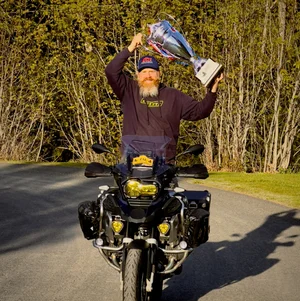
Aaron Pufal is an author, podcaster, disaster relief volunteer, Cannonball record holder, and the founder of the ADV Cannonball Rally. His literary debut, Chasing Legends: Motorcycle Stories from the Podcast Trail, won the 2026 National Indie Excellence Award for New Non-Fiction and received the International Impact Book Award for Outstanding Literary Achievement in Biographies and Memoirs. It reached number one in Amazon's motorcycles category on release, and was named to Motorcycle News magazine's recommended reading list. As co-host and producer of the ADV Cannonball Podcast, he has won the DotComm, MarCom, AVA Digital, and Communicator Awards.
Before the microphone, there were twenty-five years at sea, commanding yachts for billionaires, royal families, and heads of state.
Pufal has never signed an employment contract, a non-disclosure agreement, or a confidentiality agreement. Not once, not ever.
Availability
Publication is planned for early 2027. Editing, fact-checking, and publication are underway.
Paperback ISBN: 978-1-0673773-4-2
Hardcover ISBN: 978-1-0673773-5-9
eBook ISBN: 978-1-0673773-6-6;
Audiobook ISBN: 978-1-0673773-7-3
Library of Congress Control Number: 2026923827
You Are Family, its subtitle, and its contents are subject to international copyright protection. Literary Works Registration 1249403.