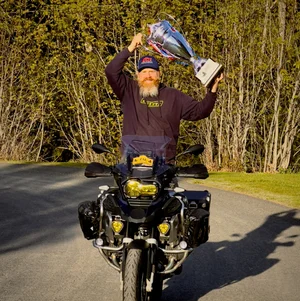
EV Cannonball Run in 100 Hours
Record Attempt · August 2026
The Electric Ghost of Cannonball Baker Sets a New Record
An Electric Motorcycle Cannonball Run in 100 Hours

The team outside the Red Ball Garage, New York City, minutes before the midnight start.
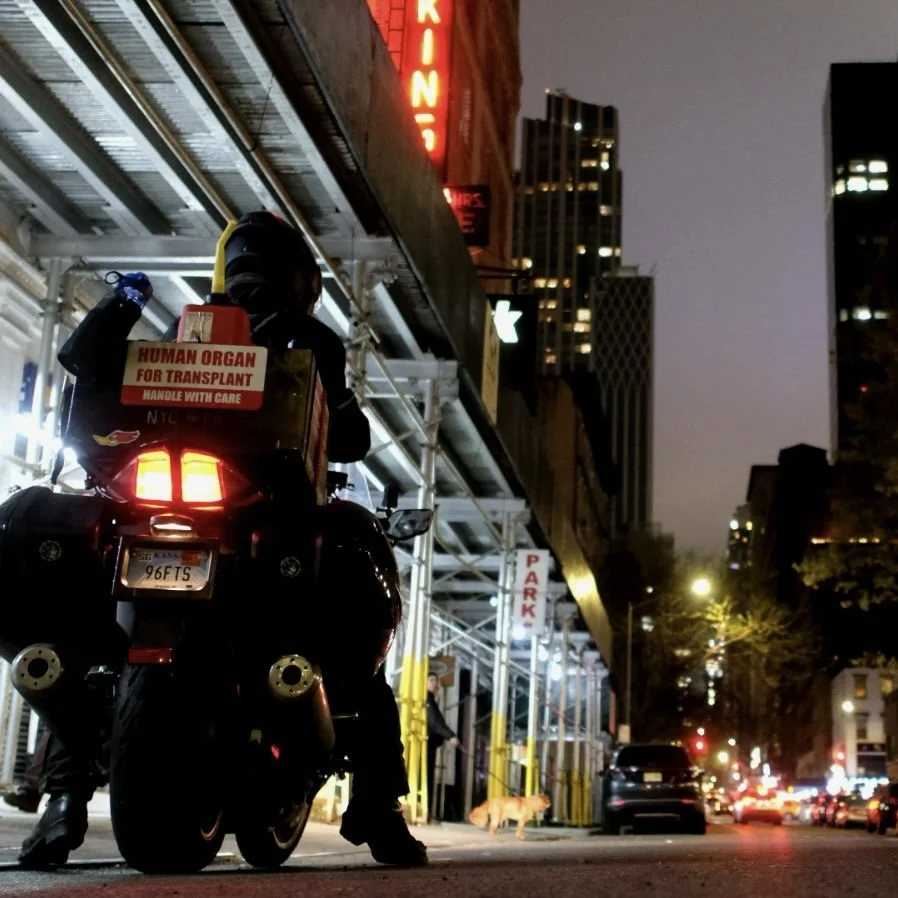
Manhattan wore its Gotham face that night, all shadow and noise and beautiful chaos. A Rush concert had just spilled its crowds into the streets, traffic coiled in every direction, construction had bled us dry of time on the way in, and scaffolding clawed up the face of the Red Ball Garage as we gathered outside at the stroke of midnight on August first. The night hung warm and thick with summer, the kind of muggy that clings to your skin and won't let go. It was so hot that I'd opted for running shoes, hiking pants, and a spring jacket, because pulling on proper riding gear for that first leg was simply unthinkable.
I climbed onto a 2021 Harley-Davidson LiveWire One, an electric motorcycle I had never ridden before, not this one, not any electric motorcycle, period. I'd driven the empty support van solo from Seattle to North Carolina to pick the bike up, sleeping in parking lots along the way, then spent two more days pushing north to New York for a symbolic midnight start. Minutes before setting off to break a cross country record, I was still about to learn how my own motorcycle worked in real time.
Legends in the Dark
On the way up to New York, we stopped to see Jay Roberts, who welcomed us with the offer of some respite, food, and camaraderie, along with words of encouragement, knowing exactly what we were about to do and exactly what we'd need at that specific point in time. Jay is a legend in the modern Cannonball community in his own right, known for setting multiple niche cross-country records, including a solo nonstop Cannonball Run, and later, together with his wife Gypsy, a semi-autonomous record of thirty eight hours in the Gonzo Prius, a modified Toyota running driver assistance technology. There was something fitting about that stop. Jay had spent years proving that experimental, cutting edge technology, the kind of self-driving hardware and software nobody quite trusted yet, could conquer this same stretch of country, and here I was about to attempt the same thing with a different unproven technology entirely, an electric motorcycle. There was a real synergy between our two attempts, two different bets on where the future of Cannonballing was headed, made by two people who apparently couldn't resist finding out the hard way.

I also want to name and thank the two Cannonballers who showed up in person to witness our midnight start, Steven and Crystal Kudler. Steven's no stranger to this world himself, and as he put it to me, echoing something Cannonball legend Ed Bolian has said, "you just need to get out there and do it." That's exactly what Steven and Crystal did in August of twenty twenty five, crossing the country in a two thousand seventeen Chevy Equinox in forty two hours and fifty four minutes. Having two people with that kind of firsthand experience stand there in the dark with us before we rolled out meant more than they probably realized.

Reality Check

The first hours were chaos and joy in equal measure. Lane filtering silently through the Lincoln Tunnel, I realized for the first time just how fast my electric motorcycle really was, a silent rocket ship slipping through gridlock that would have swallowed a gas bike whole. Once free of the city, I opened the throttle, ripping along at seventy, eighty, even a hundred miles an hour, thrilled, and burning energy at a wildly inefficient one hundred ninety watt hours per mile. It was fun. It was also, I now laugh, completely the wrong way to break a distance record. To make matters worse, within those first twenty four hours we were inundated with intense rain, wind, and lightning squalls all the way to Chicago.
After twenty two hours of riding, and being awake for forty five hours, we finally stopped at a roadside restaurant. We ran the math and didn't like what we saw, a pace on track for well over one hundred twenty five hours. Over beers and chicken wings, we rebuilt our entire approach. We divided responsibilities, wrote policies, and most importantly, agreed to stop guessing and start testing. We also decided a few hours of real sleep were worth more than pushing on exhausted, so we called it there. Ever the cheeky ones, we parked the bike right out front of the hotel and ran an extension cord out to it for some improvised level one charging while we slept, squeezing in whatever electrons we could before starting fresh at first light.
Cracking the Code
After that restaurant reset, we turned to hard data instead of instinct. Steve, our resident robotics engineer, designed a series of controlled tests, and I rode them, holding the bike at steady fifty five and sixty five mile an hour speeds, then experimenting with drafting distance behind the support van, while Steve recorded and analyzed the data in real time. The winning formula turned out to be one hundred nine watt hours per mile, tucked in at roughly one bike length behind the van at sixty five miles an hour.
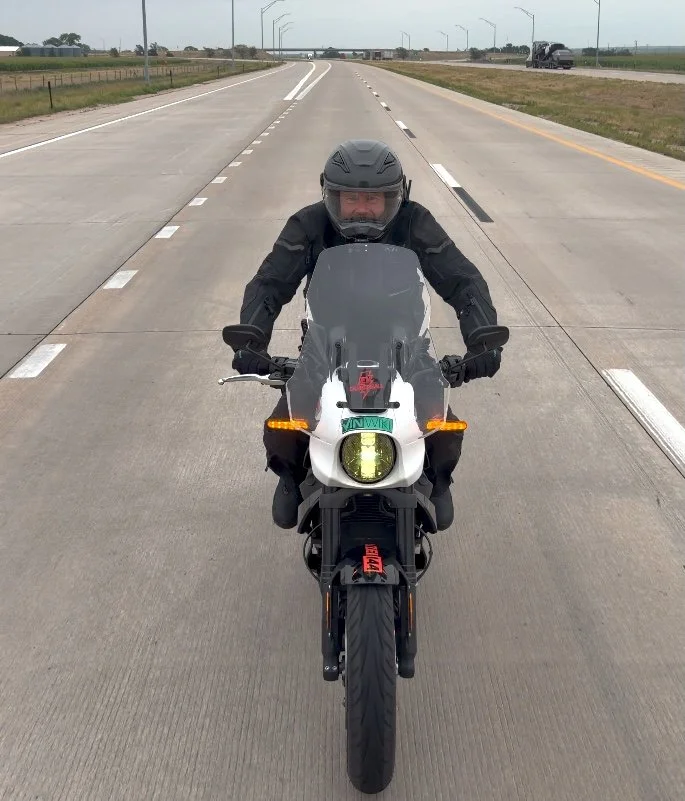
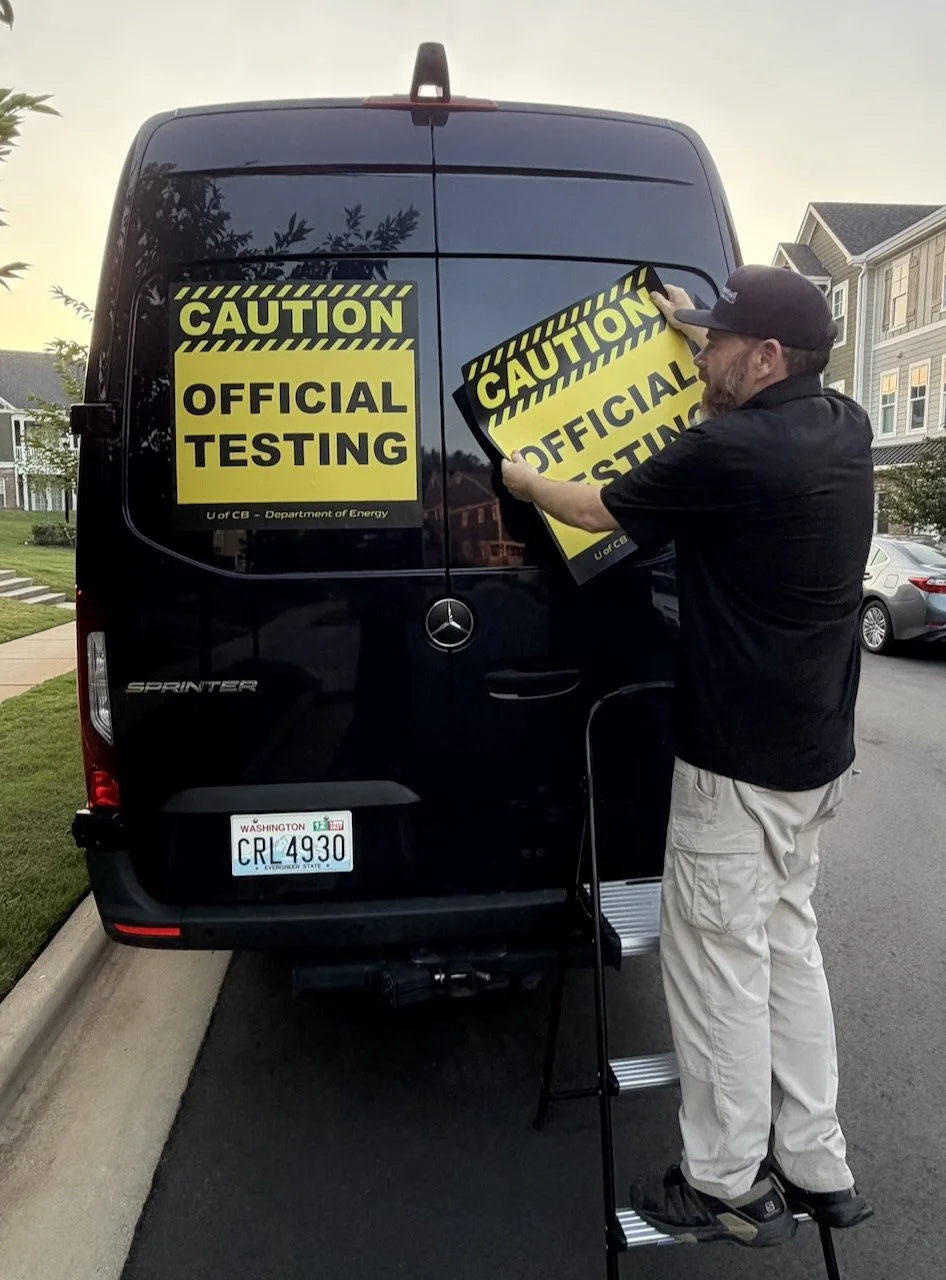
To make that drafting arrangement safer and less conspicuous, we stuck oversized magnetic signs on the van reading University of C.B., Department of Energy, and mounted a couple of strobe lights up top. It looked official enough that people assumed we were some kind of research convoy, which, honestly, we sort of were. But the real purpose was safety, making sure other drivers gave us a wide, cautious berth while I rode tucked in close behind the van for hours at a time. But that closeness was always a negotiation between speed and risk. We'd overinflated our Mitas street tires to fifty PSI chasing a little extra efficiency, but it turned the ride so brutally stiff we had to deflate them back to spec, and even then the LiveWire's solid aluminum alloy wheels and tight suspension rattled my teeth. In fairness to the tires, that was our error and not theirs. Those Mitas street tires went the entire distance, through desert heat that warped plastic and rain that came sideways, and never gave me a moment's worry. Drafting bought us efficiency but carried its own danger, tucked in tight, rough pavement could catch me by surprise and send the bike airborne for a heartbeat before I could react. Some stretches were so relentlessly rough that getting battered around back there was too dangerous to justify, no matter the gain. So when the roads turned bad enough, or rain set in, or night fell and reaction time mattered more than watt hours, we simply pulled out front and gave up the draft. Some things weren't worth the risk. Mitas Moto
Why Play Such a Stupid Game?
Before we go any further, we should probably address the obvious. Why would anyone willingly play a game this stupid? It's a fair question, so let me explain why I chose this particular record in the first place. People often ask why I didn't just go for the outright record instead of the electric one. The honest answer is money, manpower, and risk. The fastest Cannonball Run of all, in any vehicle, belongs to Arne Toman, Doug Tabbutt, and Dunadel Daryoush, who crossed the country in a staggering twenty five hours and thirty nine minutes. Attempts like that aren't cheap either, teams typically spend more than one hundred thousand dollars just to buy and build a car capable of it, before factoring in the cost of actually running it.
And it's rarely a solo act. A run like that takes a genuine team effort, often twenty or more people. At the heart of it sits central command, coordinating the run in real time. They plot traffic strategy, use AI to predict congestion further down the route, track weather in real time and lean on weather forecasting, watch traffic cameras, monitor police scanners, tap into public and other databases for real time law enforcement activity, and even track airborne police assets, sometimes rerouting the car around traffic and accidents on the fly. Out on the road is a rolling network of "blockers" watching what's ahead. Some will deliberately run in front of the record car and draw a traffic stop onto themselves, taking the ticket so the team behind them can blow through uninterrupted. And that's before you count everyone who helped build and prep the car in the first place. Some record attempts have gone even further, employing their own aircraft escorts. Alex Roy famously used a twin engine plane to help spot for police during his record run in the Polizei 144 BMW M5, when he and co-driver David Maher crossed the country in thirty one hours and four minutes back in 2006.
And that team doesn't just materialize because you ask nicely. This is a tight knit "Fraternity of Lunatics," as they call themselves, and you don't get twenty seasoned people to risk their time and reputations on your run unless you've already proven yourself within that world. Showing up as a complete newcomer and expecting that kind of support would have been laughable.
On two wheels, the outright gas powered record belongs to Beau Earnest, who did it in thirty two hours and thirty two minutes on a Yamaha FJR1300 fitted with an auxiliary fuel cell. Beau's a friend, we've actually had him on our podcast Listen, and I have enormous respect for what he pulled off. But that record demands sustained speeds well north of one hundred miles an hour for long stretches, and for reasons specific to my own personal circumstances, the legal exposure that comes with that kind of run is a risk I'm simply not in a position to take.
And on three wheels, Alex Roy went again, this time with co-driver Zach Bowman, crossing from Los Angeles to New York in a 2013 Morgan 3 Wheeler in forty one hours and forty nine minutes. Open topped, wood framed, two cylinders, no concessions, in November, averaging eighty miles an hour while dodging winter's first storms. He called it Stalingrad on wheels, and an icepick in the face of commoditized gravitas. I've got my eye on that record. My therapist has questions.
So instead, I set my sights on something nobody had officially done before, proving an electric motorcycle could make the crossing at all.
Smoke Red Sunrise
Then came Vail Pass, where the van itself hit a snag, dropping into limp mode partway up the climb into the Rocky Mountains, forcing us to creep the rest of the way over the summit at a crawl. We finally stopped in Grand Junction for four hours of real sleep, and while the rest of the team slept, I stayed up troubleshooting the van's limp mode error code, tracking it down and clearing it so we could roll out at full strength come morning.
Not long after, we rode through a smoke red sunrise, the sky stained by distant wildfires, a strange, beautiful, and slightly ominous backdrop for what came next. By this point we'd been measuring thermal performance and watt hours obsessively for more than sixty hours straight, and the data was about to matter more than ever, because we were riding straight into a war with desert heat.
The World Was on Fire
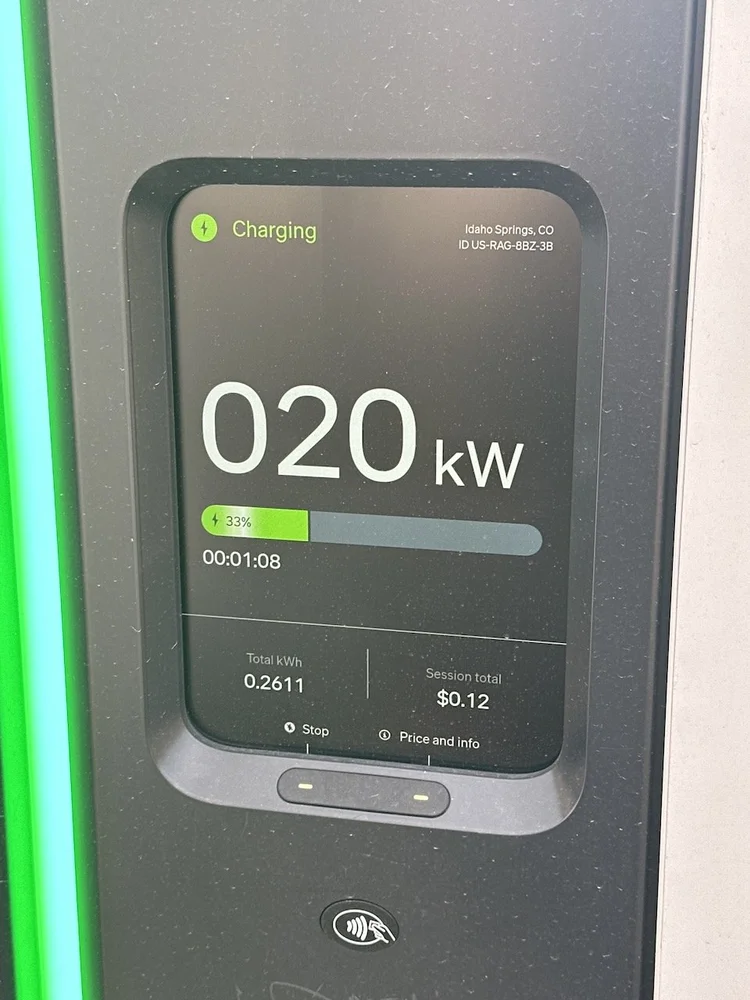
The real battle, we quickly realized, wasn't speed or range anxiety, it was heat. Specifically, keeping the battery's own temperature under control while we discharged and recharged it continuously, hour after hour, for the better part of one hundred hours straight, with no real break to let it cool. Across the whole run we performed forty seven separate level three DC fast charges, and it was that relentless cycle of repeated fast charging that drove the internal battery temperature to its worst, swinging brutally from a manageable seventy nine degrees to a scorching one hundred eighteen degrees after back to back sessions. Once it climbed too high, thermal throttling kicked in hard on the charging side. Where a cool battery would happily pull as much as twenty kilowatts, a badly overheated one could crawl down to just five, dramatically slowing how fast we could refill it. Discharge, oddly enough, was never the problem, if anything the bike delivered its power just fine in the heat, it was getting energy back into the battery that ground to a halt.
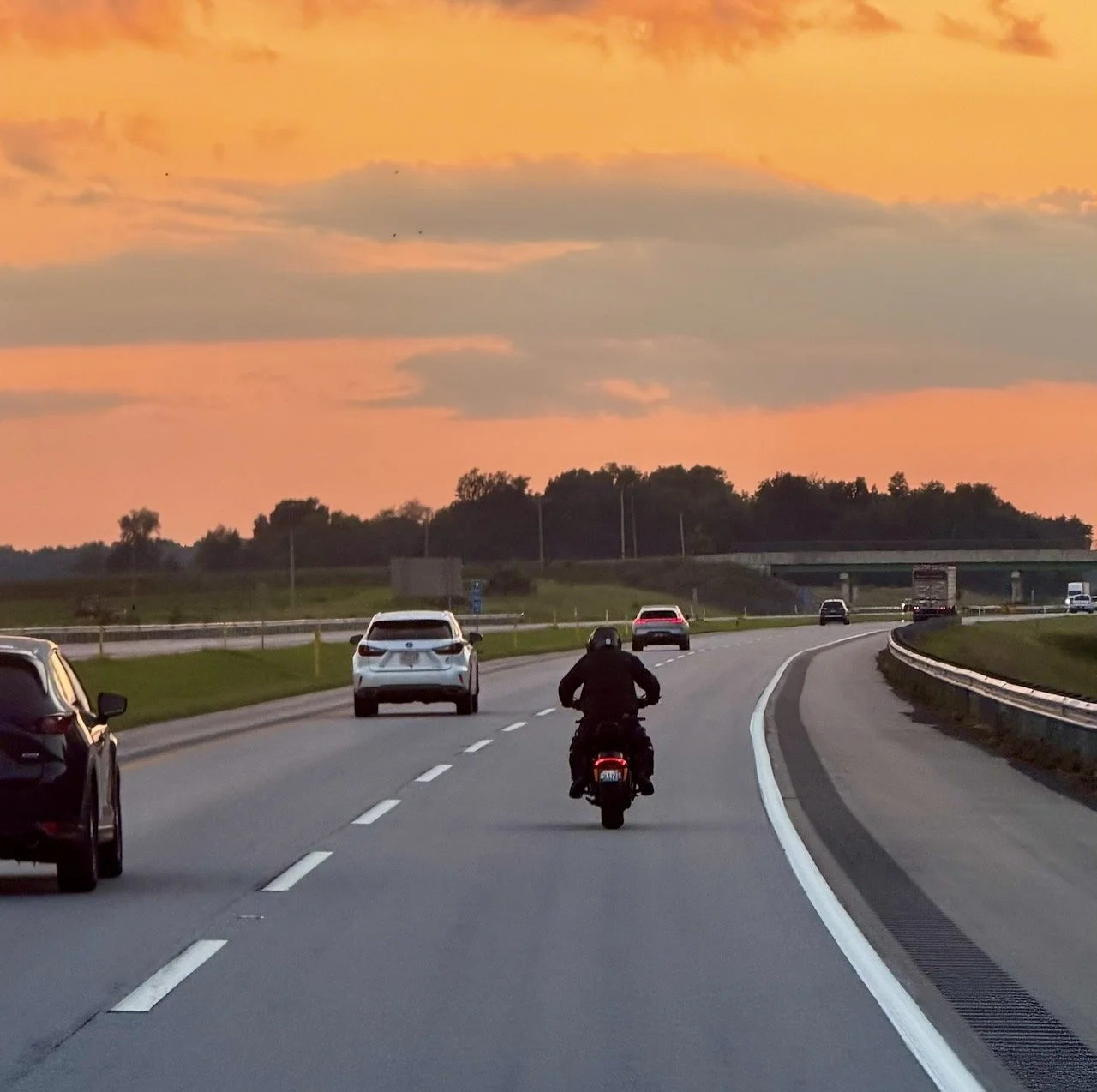
On the final day, air temperatures in Utah, Nevada, and California hit one hundred thirteen degrees Fahrenheit, and the heat started attacking the hardware itself. And the land was burning. All three states were literally on fire, wildfires chewing through the high desert and the forests beyond, and the smoke hung so thick in the air that every breath felt borrowed. I was riding through a furnace that someone had forgotten to ventilate, the sun reduced to a dull orange coin behind a curtain of ash. There's a particular kind of loneliness in racing silently across a continent that appears to be actively trying to cremate itself, and somewhere in that haze I stopped thinking of the heat as weather and started thinking of it as an opponent with a grudge.
The retention pin on the D.C. fast charging socket itself actually warped from the heat, and the bike's own software started glitching, what we jokingly called ghosts in the code, until a full reset of the bike's systems got things stable again. Even our phones were overheating and shutting down. I ended up rationing water across each leg, keeping bottles stuffed in my pants pockets since I wasn't wearing a jacket, and every so often I'd crack one open and pour it straight over my body to cool myself down, carefully spacing them out to make sure I had enough to keep from physically overheating before the next charging stop.
No Such Thing as an Easy Charge
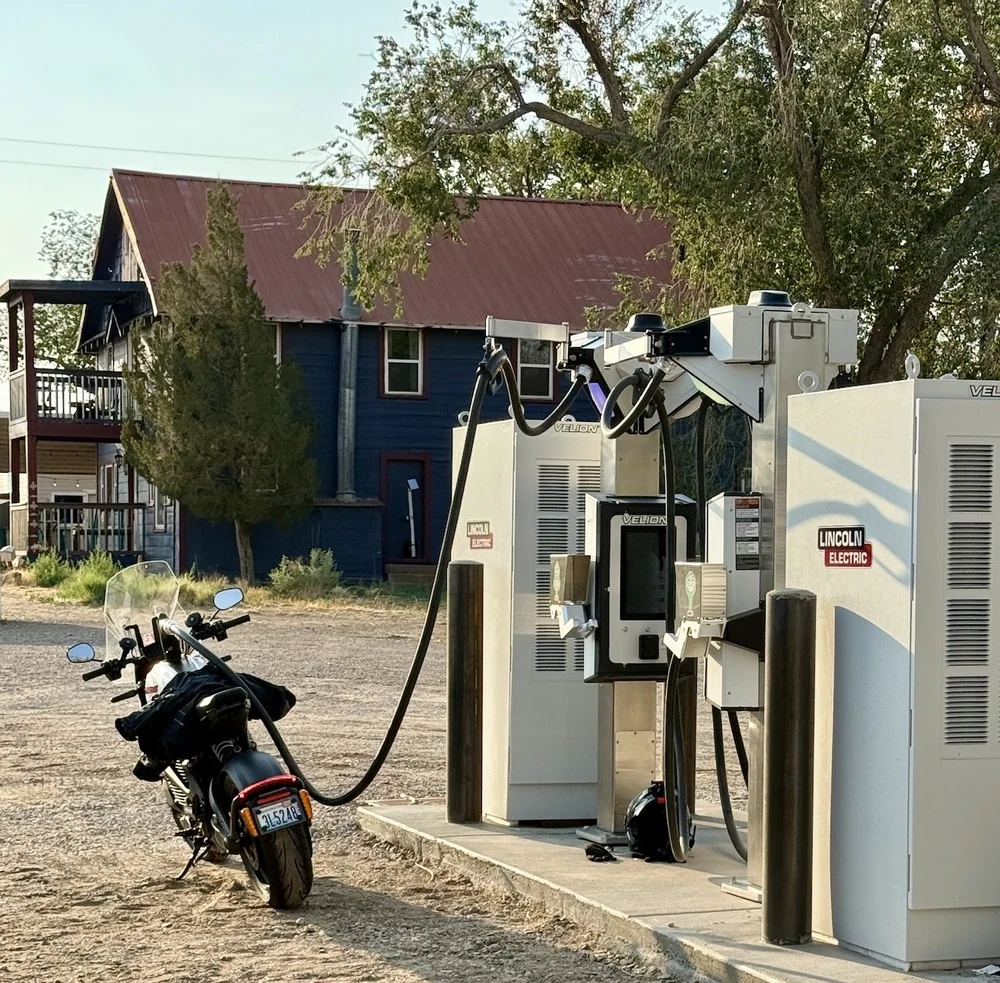
We learned early, and the hard way, never to roll into a dubious, poorly documented charging point running on fumes whenever we could help it. Arriving with a little margin left in the pack meant that if a charger turned out to be dead, missing, or on the wrong side of the interstate, we still had options, rather than being forced to fall back on the onboard level one charger, which takes hours to add meaningful range instead of the near minutes we got from the level three fast chargers we relied on. That said, we also leaned heavily on real time online charger statistics, and at some of the more popular, well used stations we could actually see that a charger had been used successfully that same day, sometimes only hours before. In those cases, confident in our own data and our consumption numbers, we'd let ourselves come in on as little as one percent, as we did several times, weighing the totality of the circumstances and genuinely pushing the limits, and getting away with it.
Not every charger cooperated. Sparse, gray market charging stations along our rural route worked as little as one in four tries, and addresses often pointed to empty desert instead of an actual charger, forcing us to lean on satellite maps and our van's Starlink connection just to hunt down the right spot. Our favorites, by far, were the Flying J stations, which had the decency to put their fast chargers under real cover, shelter from the sun and rain that most other networks left us baking or soaking in.
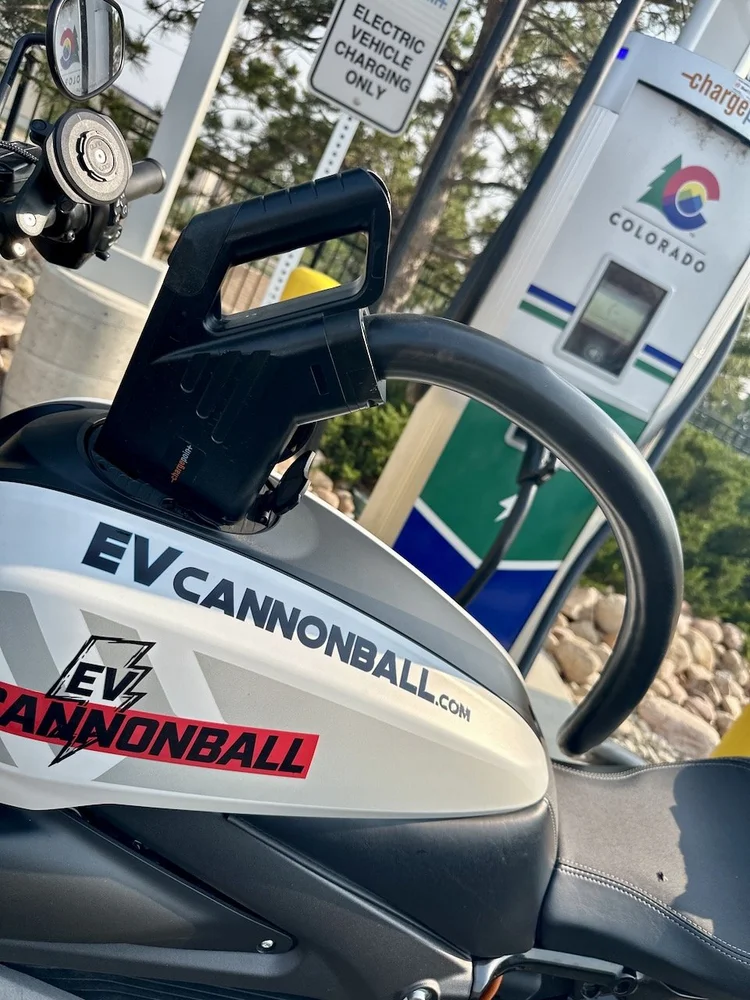
I'd imagined, before any of this started, that charging stops would be small mercies, a chance to lie back and nap while electrons did the work. The reality was the opposite. Every stop was packed wall to wall with tasks, cleaning a dirty visor, recharging comms and strobe lights, double checking the routing app's next charging stop recommendation, rehydrating, shoving some food in your face, and relieving myself at record pace, because on a run like this even a number two becomes a strategic decision with a stopwatch running. Nobody rested. If anything, the stops were busier than the road.
Standing Watch
Sleep, or the lack of it, became the enemy's sharpest blade against us. After a grueling first day and a six hour sleep to recover, we adopted a rule, once the sun went down, two people stayed awake in the van at all times, because drafting mere feet off the bumper at night meant a single moment's delay spotting road debris could cause a serious crash. We stayed connected the whole way through, me in helmet comms with in-ear monitors, my driver and co-driver on their own mesh network headsets, so a warning could travel instantly. By day two, the pain and fatigue were real enough that I started keeping loose ibuprofen in my pants pocket, just to get through each leg.
The All Star Team
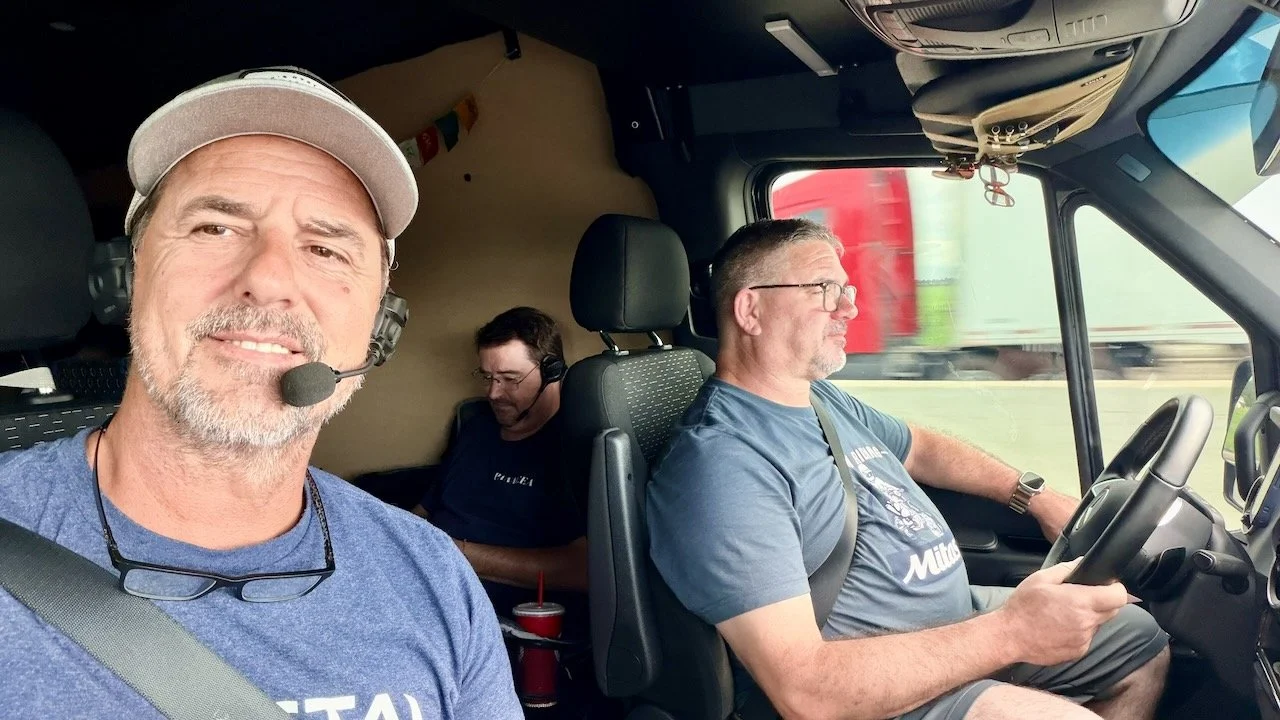
What began as a crew of four became three after Hunter Wray, a US combat veteran and the overall winner of the twenty twenty five ADV Cannonball rally ADV Cannonball, had to fly home from Denver. The rest of us leaned hard on our individual strengths. As a former yacht captain, I knew that surviving something like this isn't about muscling through on willpower, testosterone, and caffeine, a strategy that stops working somewhere around your fortieth birthday, and we were all comfortably past that. It's about disciplined watch systems. Running a boat on long passages taught me how to structure a rotation, when to put people down to rest and when to wake them, so that fatigue never got the chance to compromise the mission. I brought that same approach to organizing our shifts and keeping the team sharp around the clock. Beyond that, I was really just the dummy riding the motorcycle. Steve Walmsley, a robotics engineer and computer programmer, brought the technical rigor behind our data driven testing, and it was Steve who recorded every data point along the way and led the post attempt analysis that would make sense of it all. And Kerry LeBel, a former executive at Amazon and Microsoft and currently a successful entrepreneur, and the editor of my last book, "Chasing Legends," stepped up as our team leader and chief engineer. He became our main driver and took charge of charger planning, making optimization calls that seemed counterintuitive at first but proved out as the rest of us caught up to his logic. Kerry's an accomplished rider himself, which meant he understood exactly what I was dealing with out there on the bike. We learned to trust the math, even when it defied instinct, some charging stops were as little as forty five miles apart, while others stretched out to a hundred.
Ghosted by LiveWire
One frustration lingered the whole way through. We reached out to LiveWire before the attempt, hoping for technical guidance on battery behavior and charging optimization, and never heard so much as a word back. Apparently the ghosts weren't just in the code. A single conversation with an engineer might have saved us hours we otherwise spent learning by trial and error. That said, credit where it's due, this was clearly no corner cutting machine thrown together to hit a price point. It's an extremely well engineered, well built motorcycle, and apart from those heat related software gremlins I mentioned earlier, it never had a single real mechanical issue while crossing the continent. When electric motorcycles see wider adoption, I have no doubt manufacturers would iron out those last few quirks quickly, but the bones of this bike, the engineering underneath it all, deserve real praise.
Russian Roulette
At that last charging stop, we stood around debating the one calculation that mattered most, how much charge was actually enough. It came down to a negotiation between me and physics, I kept insisting I could ride faster, and the battery kept quietly disagreeing, with the laws of thermodynamics refereeing, and they don't take bribes. Whatever we decided, we were already committed to playing the world's stupidest game of Russian roulette, the only question was how many chambers we wanted loaded. Stop too long and we'd throw away precious time we couldn't spare. Stop too little, and picture crossing thousands of miles of mountains, deserts, and lightning storms, only to coast to a dead, silent stop on some Los Angeles surface street, two miles from the finish, stranded like a kid who blew his whole allowance on candy in the first five minutes. No support plan, no dignity, just me and a very expensive paperweight. While we debated, we did a live broadcast to the C2C Express Facebook page, alerting our "Fraternity of Lunatics," the die hard Cannonballers who'd followed us the whole way, to make sure enough people were watching and ready to help officiate the finish.
One Last Gamble
Leaving that last charging stop in Covina, California, just outside Los Angeles, the math was done and the dice were already in the air. I wanted to race the last stretch righteously. Not necessarily as fast as humanly possible, but hard enough that the finish would be worthy of everything that came before it, and still not so hard that I'd coast to a stop short of the line. So I rode it like a puzzle. Over a hundred miles an hour for long stretches, then easing back to sixty to watch where the battery would settle, recalculating with every mile, hunting a finish that would land with one or two percent left in the pack. And just as critically, making sure the soundtrack in my helmet was correct, Rage Against the Machine hammering in my ears as Los Angeles blurred past on either side. It was every bit of pace I could pull out of that bike without gambling the whole record on the last few miles.
But let me be clear about one thing. No matter how disciplined and scientific the previous hundred hours had been, the ending could not be a polite little drafting exercise. Picture telling this story years later on a channel like VinWiki, in a studio still holding the echoes of every legend who sat in that chair before you. You simply cannot look into a camera and say the climax of your Cannonball was tucking neatly behind a van and coasting gently to the line. No. A Cannonball story has to be earned. The gravitas of an attempt like this demands the respect of real speed at the end, for the sake of everyone who came before me. It has to have you ripping across the city, threading traffic, running the odd red light, heart pounding, drama crackling in the air. And think of the officials watching my little dot crawl across the tracking app in real time. What would they have thought if I rolled up to the Portofino at a leisurely thirty miles an hour? These are Cannonballers, they deserved better than that, and honoring them properly was the least I could do. The mission had been a grueling marathon, but the finish, the finish had to be a sprint.
Into the Books


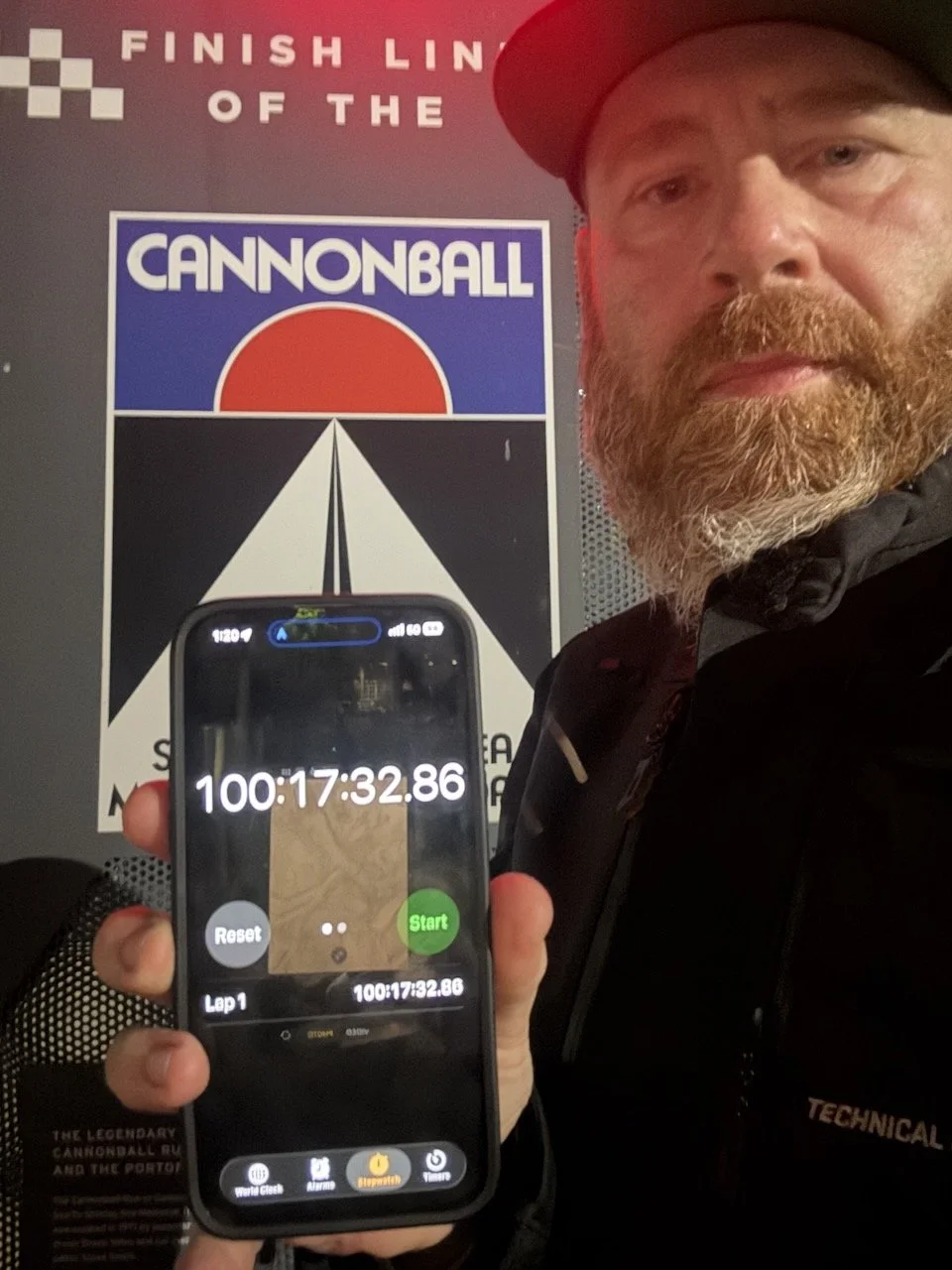
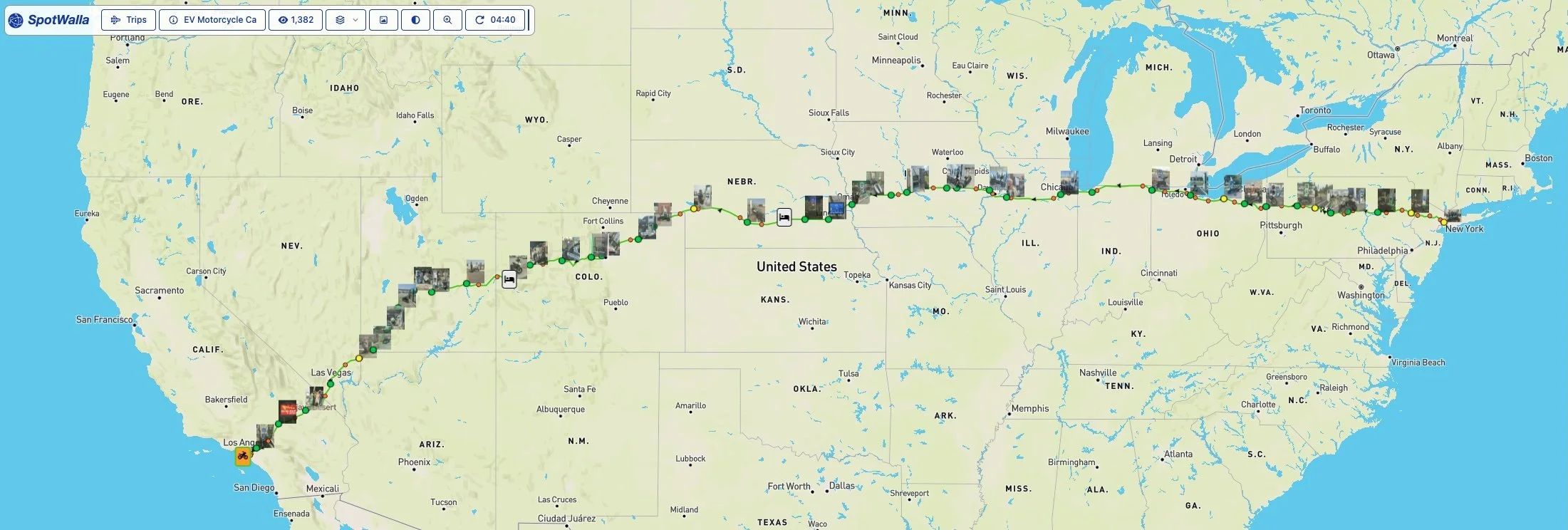
I crossed the finish line at the Portofino Hotel with an official time of one hundred hours and seventeen minutes, seventeen minutes I know for a fact we could have clawed back in a dozen small ways. We'd taken the northern route, more than two thousand nine hundred and fifty nine miles in total, and put the bike on a charger forty seven times to do it. And true to the cliche of every cannonball attempt before mine, the finish itself was almost comically anticlimactic. No crowd, no fanfare, just a handful of photos, a few congratulatory comments from the diehard Cannonballers who'd stayed up all night on the tracking app to witness and officiate, and then straight to the hotel to pack the bike away and collapse. The next day, sore in ways I hadn't anticipated, nursing wind burn and sunburns, with a fifty year old body filing its complaints one joint at a time, we finally got our real celebration, beers and dinner at the hotel, including one fittingly named Cannonball Run I.P.A.
Setting the Record Straight
Earlier riders have claimed similar electric crossings, including one reported seven day attempt by Diego Cardenas on a Harley-Davidson LiveWire, and another claimed run of one hundred eleven hours in the reverse direction by Steven Day on an Energica EVA Ribelle. To be clear, I'm not disputing either run. Both riders were generous with their support in real time throughout ours, and I'm grateful for it. I simply wanted mine held to the gold standard, approved in advance by Cannonball record holders and verified throughout via GPS tracking and community spot checks, the same standards used for the underground sport's traditional gasoline powered records.
What Comes Next
Looking back, I realize we never once test rode the motorcycle before leaving the Red Ball Garage, a decision that made for a funny story but cost us significant time. I keep a private list of changes I'd make to shave hours off the record. I won't be doing it again on this particular LiveWire, but the idea of chasing my own record on newer, more cutting edge machines is tempting, especially bikes built around removable battery packs, which could change the entire charging equation. I'd also love to try it on a bike with real charging headroom, something that could actually sustain a hundred kilowatts without heat soaking and throttling itself down the way we experienced. One machine I've got my eye on is the 2026 Verge TS Pro, which claims, and I use that word very carefully, to run on a solid state battery capable of a ten minute fast charge, driving their hubless Donut motor. If that claim ever fully materializes, it wouldn't just cut down the number of charging stops, it could make them almost instant, and the heat soaking that plagued us in the desert would essentially stop being a problem. That's a big if, not one of the promised solid state bikes has actually been delivered yet, which puts it squarely in vaporware territory until proven otherwise, and there are plenty of skeptics, but if the technology proves real, it would be a genuine game changer for a run like this. Verge is a Finnish company led by its CEO, Tuomo Lehtimaki, and I'll admit I'm wary. We've all watched this movie before, a charismatic tech founder announces some miracle technology, hoovers up a mountain of investor cash on the strength of a press release, and then quietly walks away when the thing never quite ships, leaving the company to collapse behind him. So my honest reaction is simple. Why all the bullshit? Why not just build the damn thing, release it, and let the machine do the talking? If Verge actually delivers a working solid state bike, I'll be first in line to eat my words and throw a leg over it. I've also got my eye on attempting a run that's entirely solar powered, an idea I've already started quietly planning around. Attempts like these are wildly expensive undertakings, there's no getting around that, but they are every bit as rewarding as they are costly.
Chasing Baker's Ghost
There's something fitting in all of this, too. In 1914, riding an Indian motorcycle that was still very much unproven technology, Erwin "Cannon Ball" Baker rode from San Diego to New York in eleven and a half days, shattering the previous transcontinental record by nearly nine days, on roads that were mostly dirt, with no support network, no spare parts network, nothing but grit and a machine that had barely been tested at that distance. He'd go on to set that Three Flags record from Canada to Mexico the following year, and eventually crossed the country by car too, in fifty three and a half hours, the very run that decades later inspired the Cannonball Run races and eventually the movies that made his name a household word.
What strikes me is that Baker was always chasing the newest, least proven technology of his moment, first motorcycles that had only existed for a decade, then early automobiles nobody trusted to survive a cross country trip. He'd sometimes show up to these runs and swing a leg over a machine he'd barely had time to learn, and simply go. There's a reason that felt familiar to me. I'd climbed onto my own LiveWire at the Red Ball Garage that first midnight having never ridden it, or any electric motorcycle, before in my life. I like to think Baker would have found that funny, watching me learn throttle response in real time with the clock already running, caught out by the sudden bite of regen every time I expected to coast, because it's exactly the kind of thing he used to do to himself on purpose. I should say clearly, I'm no evangelist for electric vehicles or green technology. But let me be just as clear about the clowns on the other side. I've got zero patience for the muppets who insist windmills cause cancer, that clean coal is anything other than an oxymoron with a lobbying budget, or that every electric vehicle is one pothole away from bursting into flames before it can limp past the corner store. Both extremes are exhausting.
I didn't do this to join a team. I did it for the oldest and most stubborn reason there is, because it was hard. Because somewhere along the way a thing being nearly impossible stopped being a warning and started being the entire point. Nobody needed an electric motorcycle dragged across a continent, and that's precisely why it had to be me, and why it had to be now. The engineering fascinated me, the challenge was real, and physics doesn't check which team you cheer for before it decides how far a battery will go. And for the record, I don't cheer for any team. I just wanted to see if it could be done. It can.

But everywhere we stopped, from gas stations to charging points, the very first question was always the same, boring, predictable, and utterly without imagination, "how far can that thing actually go?" There's a whole crowd of naysayers out there convinced electric motorcycles simply can't do real distance, can't be trusted beyond a joyride around town, and our answer, every single time, was that it can go clean across the whole damn country, and for the record, in less time than most of you would manage in your five thousand pound G-Wagon with the air conditioning cranked and an eight dollar oat milk iced latte sweating in a cupholder that cost more than my helmet.
We did this because it was hard, and because somebody needed to prove it could be done. In some strange way, doing this on an electric motorcycle feels like the closest thing to Baker's original spirit left in the world today, strapping yourself to technology still being figured out in real time, and betting on it anyway. And there's a rawness to doing it this way that a gasoline crossing simply doesn't demand anymore, being entirely dependent on someone else's charging infrastructure, scattered, sometimes finicky, and not always where the map says it'll be, while your own body is left exposed to whatever the sky decides to throw at you. The bitter dawn air in the Rockies, cold enough to reach clean through to the bone. Lightning and driving rain squalls hammering us for the first twenty four hours straight. A blow dryer heat in the desert that warped plastic and rattled the bike's own code. Riding through all of that, at the mercy of both the grid and the weather, is its own kind of true grit, the kind you can't buy your way out of. And if this run pushes even one more rider to come chase this record down and beat it, then it did exactly what it was supposed to do.
Smiles Per Mile
One final thing. Now that it's all done, I'll admit something I didn't expect to. This motorcycle is genuinely cool. Mind you, I still need to confirm it can pull a proper wheelie and hold a decent brake stand before I fully commit, a man has standards. But it's fast as hell, scary fast, the kind of fast that rearranges your face, and for ripping around a city it's an absolute riot. It puts a stupid grin on you every single time. And isn't that the whole point of a motorcycle? Here's the funny part. I had every intention of selling the thing the moment I crossed the finish line. I told myself I had no attachment to it, especially after being ghosted by LiveWire themselves. But a part of me is going to hang onto it. I don't know for how long, I don't know how long the novelty lasts. But for now, I'm keeping the bike. Because it's cool. Baker would have understood that part too.
Aaron Pufal, real Cannonballer
Watch the run
Hear the full debrief
ADV Cannonball Podcast Electric Motorcycle Cannonball Record SetAlso covered in