From Patagonian Dreams to the Frontlines
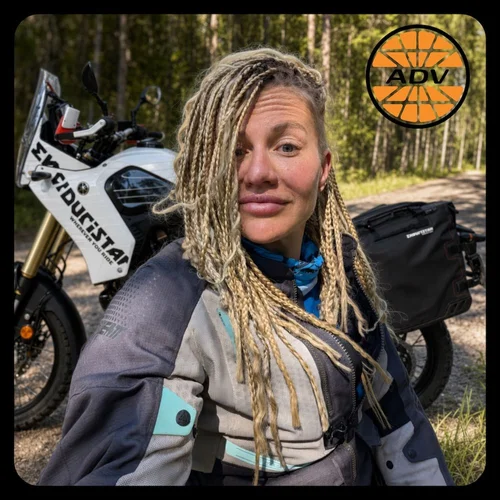
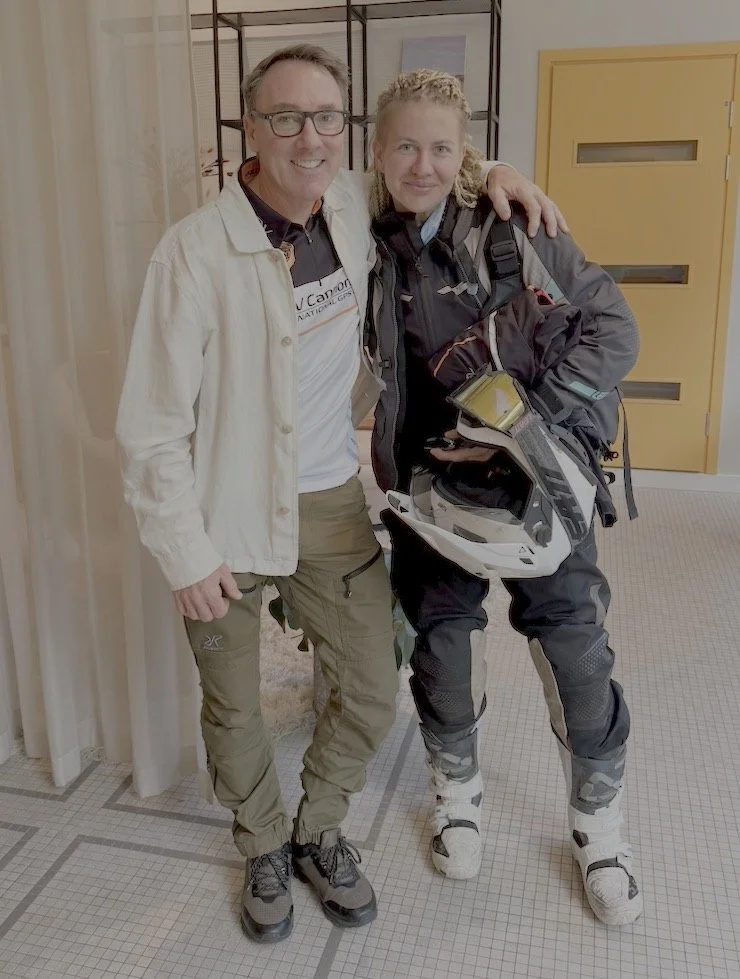
Season 6, Episode 8 of the ADV Cannonball Podcast recently featured Lithuanian writer, rally competitor, and humanitarian Eglė Gerulaitytė in a wide ranging interview conducted by host Taylor Lawson. What emerged was far more than a typical motorcycle podcast. It was a meditation on freedom, sacrifice, and what it truly means to put your convictions into action.
There's a particular breed of adventurer who doesn't merely talk about changing the world. They strap on a helmet and ride directly into the chaos. Eglė Gerulaitytė is precisely that kind of person.
Now serving as Content Growth & Digital Marketing Director at Enduristan, Gerulaitytė's professional title barely scratches the surface of a life lived on dusty trails in wild places. She's a three time published author, a rally competitor who proudly claims eighty sixth place as her "absolute peak achievement," a founder of women's adventure touring company Big Little Rides, and most recently, a machine gunner in Company 206 of the Lithuanian Armed Forces.
The Geography of Freedom
To understand Gerulaitytė, you must first understand the Lithuania she grew up in. A nation trapped behind the Iron Curtain, where the word "stuck" wasn't metaphorical.
"Growing up, I was quite convinced that the most exotic place I'd likely ever see would be, I don't know, Paris at best," she told Lawson. "My parents' generation was just stuck. You couldn't travel west at all. It was illegal."
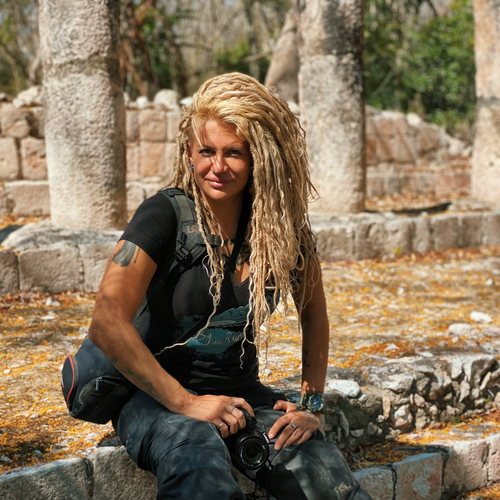
Her father, a music history professor, was once sent to Stockholm for a composer's conference. One of the rare occasions a Soviet era Lithuanian might glimpse the world beyond the Iron Curtain. Her mother asked him to bring back sneakers for young Eglė, but convinced the sizing would be different, she measured her daughter's foot and cut a stick to that length.
"My poor dad had to go to some shoe store in Stockholm with a stick and ask the shop assistants, 'Can I please have sneakers this size?'"
When Lithuania regained independence in 1990, the Iron Curtain finally fell. The borders that had imprisoned generations dissolved. Then, in 2003, Lithuania joined the European Union, further opening pathways to the West. For Gerulaitytė, this meant one thing: escape velocity.
At eighteen, she hitchhiked to Spain. The journeys never stopped. This wasn't gap year tourism or Instagram curated adventure. This was salt of the earth travel. The kind that builds authentic character through truck stop conversations, cold nights under bridges, and the generosity of strangers. The kind where opinions are earned through experience rather than inherited from algorithms. Where understanding comes not from scrolling but from sitting across a kitchen table from people whose language you barely speak, sharing bread and stories until the words don't matter anymore.
But freedom, she would later discover, is not evenly distributed. In 2013, she landed in Arequipa, Peru, working with children in the slums. Those children were trapped too. Not by Soviet borders, but by poverty so crushing it functions as its own kind of prison.
Here's the brutal truth most Westerners never confront: they're born holding a winning lottery ticket and mistake it for merit. A passport from the right country is worth more than talent, intelligence, or work ethic. It's the ultimate privilege, invisible to those who possess it. No visa applications to deny when you can't afford food. No travel restrictions necessary when the next neighbourhood might as well be another continent. The accident of geography determines everything, yet those born on the fortunate side of arbitrary lines lecture others about bootstrap pulling and personal responsibility.
Gerulaitytė understood this viscerally. She'd escaped one cage only to witness another. The children in Arequipa's slums possessed the same dreams, the same potential, the same hunger for freedom she'd felt growing up. Most would never even hold a passport, let alone understand what one represents. The only difference between her and them was the randomness of coordinates at birth. That recognition, that uncomfortable reckoning with the lottery of privilege, would fuel everything that followed.
It is a strange thing to consider how much of a life is decided before the life has even begun. Not just the border printed on a passport, but the god handed to a child in a crib, the prayer taught before the alphabet, the faith absorbed the way skin absorbs sun, without consent or choosing. Jeremy Kroeker traced this same fault line in Season 3 of the ADV Cannonball Podcast, turning the accident of geography over in his hands and finding, underneath it, the accident of religion. Believers rarely choose their belief so much as inherit it, the way a river inherits its banks. Gerulaitytė's story asks the same quiet question from a different angle: how much of what we call conviction is simply the current we were dropped into before we ever learned to swim.
"I'd never seen poverty of this sort of scale and level. I'm not proud of it, but I didn't last very long just because I couldn't quite cope with it."
What happened next changed everything. While backpacking after her volunteer stint, a rider named Ryan taught her the basics in a dusty parking lot. The next day, she bought a 150cc Zhongshen because she preferred the blue one over the 250cc Ryan recommended for the Andes. "'CC' meant absolutely nothing to me back then."
What was supposed to be a few months became two years traversing the entire South American continent, and eventually a book, Tales from South America.
Ukraine: This Is Not Television Politics
There's a moment in the interview where everything shifts. Gerulaitytė has been running humanitarian missions into Ukraine since the 2022 full scale invasion, delivering four by four evacuation vehicles, medical supplies, and dirt bikes to combat units near Kharkiv.
"This conflict hits very close to home," she said. "Historically, we've experienced what Russian occupation is like. Very up close and personal."
Her grandfather spent twelve years in a Siberian gulag coal mine for telling jokes about Stalin. For listeners of the ADV Cannonball Podcast, that detail carries particular weight. The gulags of northeastern Siberia were directly connected to the Kolyma Highway, known to adventure motorcyclists worldwide as the Road of Bones. This legendary route, built between the 1930s and 1950s by gulag prisoners, has been featured on the podcast numerous times. Charley Boorman traversed it. Lyndon Poskitt documented it. Austin Vince made it famous in Terra Circa. For riders, it represents the ultimate test of endurance.
But for Gerulaitytė's family, it represents something far darker. Tens of thousands, possibly hundreds of thousands, of prisoners died constructing that road. Camps like Butugychag, Susuman, and Yagodnoye served as way stations of suffering along the route that adventure motorcyclists now ride as a bucket list challenge. The ruins remain. Occasionally, overland travellers photograph them.
The road that represents freedom and adventure to Western riders was built on suffering like her grandfather endured, and on the bones of the many who never made it out. The same system that imprisoned her family now invades Ukraine.
She tells the story of Svetlana, a horse trainer from Svetohirsk, an area known for expensive spa resorts and Olympic level equestrian facilities. When the invasion began, Svetlana sent her prize horses toward Kyiv. Then came a phone call: "You need to pack your kids into your car right now and go. Not in an hour. Now."
She sent her children away. But she knew the employees at a smaller local stable were still there. So she went back.
"Everybody got on horseback. Everybody. The employers. Everyone. And they literally galloped across the woods as they were being shelled."
Gerulaitytė pauses.
"Not all of the riders made it..."
When Svetlana reached Kyiv, she sold all her prizes, donated the money to the armed forces, and returned after liberation. She now works with older schoolmaster horses, inviting soldiers for forest rides so they can "just be normal, forget the horrors for an hour."
This is what war actually looks like. Not talking heads on cable news. Real people making life and death decisions. Property destroyed. Businesses bankrupted. People dying beside you while you ride a horse through shellfire.
The blowhards who offer tacit support for this criminal violence from the safety of their living rooms have never been shelled while trying to save their employees. They've never had to choose between their children and their people.
Putting Your Bike Where Your Mouth Is
It would be easy to simply donate money and post about it. Gerulaitytė did far more.
In 2024, she organised a fundraising ride. Six countries in sixteen days. The goal was a fully equipped four by four for Ukrainian combat medics. The recipient was Nastya, a twenty seven year old medic from Kharkiv who dreams of opening an animal rescue center for veterans after the war.
But somewhere in the Czech Republic, Gerulaitytė made a decision. Her round the world travel plans were going on indefinite hold. She was going home to join the Lithuanian Armed Forces.
"I had a great run. I had the freedom and the opportunity to have all these adventures. If this Russian aggression is not stopped, the Baltics might be next. I felt like it was time for me to do my part."
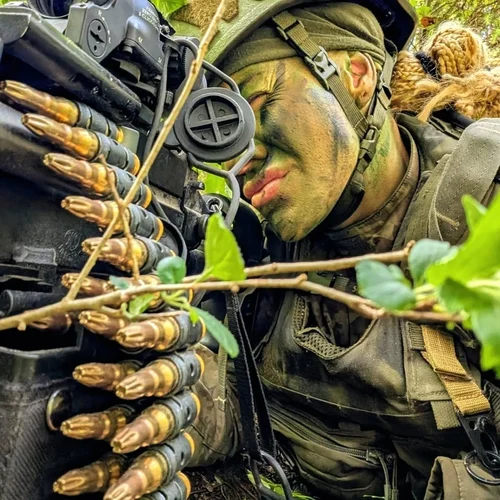
She didn't know if the military would accept her. A forty year old with zero experience. But she passed the checks, the evaluations, the training. She's now a machine gunner in Company 206.
And then there was Lucy.
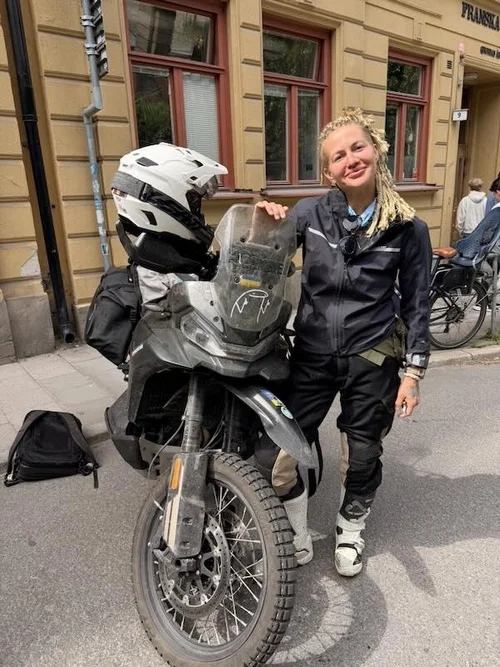
Lucy was the DR650 she'd ridden for nine years. First named "Lucifer" because the 650cc seemed massive compared to her blue Zhongshen. They'd crossed continents together.
"I could never sell it. No way in hell would I sell it."
But as she rode toward Ukraine, she realised there was one more thing she could give. She connected with Andre, an officer teaching soldiers to ride motorcycles for mobility. She rode Lucy to Lviv, handed over the keys, and took a bus home while drones and shells fell around the country she'd just left.
That's not virtue signalling. That's not posting a flag emoji. That's true sacrifice. That's putting the rubber to the pavement.
"It's Just Obvious"
When Lawson asked about the thread connecting her early volunteer work in Peru to her current military service, Gerulaitytė's answer was characteristically humble.
"I just feel obscenely lucky. The ability to travel, to have all these adventures. It's just down to luck. Just because of where I was born. There's so many people in worse circumstances purely for geographical reasons. So I think... yeah, it's just kind of obvious."
Obvious.
For most people, the obvious response to global injustice is a social media post. For Gerulaitytė, the obvious response is learning to operate a machine gun, giving away her motorcycle, and taking a bus home from a war zone.
"I have this low key ongoing guilt that I'm not doing enough. What those people are facing, the resilience and humanity they show every time I go there. It's absolutely mind blowing. I think we should all be doing a lot more."