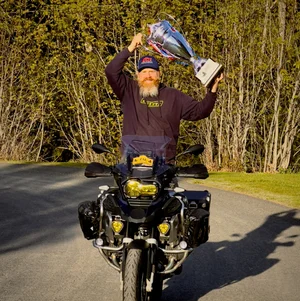
Stuart Barker on the Isle of Man TT
There are motorcycle races, and then there is the Isle of Man TT. No other event on earth asks so much of its riders, draws so fiercely devoted a following, or generates so much debate about whether it should exist at all. In the Season 5 premiere of the ADV Cannonball Podcast, host Taylor Lawson sat down with Stuart Barker, one of the most respected voices in motorcycle journalism and the author of Ragged Edge: The Brutal Story of the Isle of Man TT, for a conversation that is as honest as the event itself.
▶ Listen to the full episode on Buzzsprout
Who Is Stuart Barker?
Stuart Barker came to motorcycles the way a lot of great loves begin: unexpectedly, and all at once. Growing up in Scotland, he caught the 1983 British Grand Prix on television after his father called him downstairs with the words, "It's just like Silver Dream Racer." Watching Kenny Roberts wheelie across the finish line, Fleetwood Mac playing on the broadcast, Barker was done for. He went into town the next morning and bought a copy of Motorcycle News and a red baseball cap to look like Kenny Roberts' mechanic.
He did not actually start riding until 1996, when he joined MCN at age 26. And when he finally took his test, he did it the way only a motorcycle journalist would: on a Honda Super Blackbird, the fastest production bike in the world at the time, on icy January roads, with zero prior riding experience. Three riding schools had refused to take the assignment. He passed.
Over the nearly three decades since, Barker has written eleven books for publishers including HarperCollins, Random House, and Haynes. His Barry Sheen biography cracked the top four in both the UK and Australian charts. His history of the TT was nominated for the British Sports Book Awards. His Evil Knievel biography has been optioned for a major motion picture. He also edited the official Isle of Man TT programme for close to a decade.
Road Racing vs. Circuit Racing: Why the TT Is Different
For listeners new to road racing, Barker breaks it down with the clarity that only comes from a lifetime inside the sport.
When motorcycle racing began in the early 1900s, a blanket 20 mph speed limit across the UK made closed-road racing impossible on the mainland. Organizers approached the Isle of Man government, which has its own parliament and could close public roads for competition. The first TT was held in 1907, and the template for road racing was born.
The difference between that and modern short-circuit racing could not be more stark. At a purpose-built circuit like Silverstone, spectators watch from grandstands hundreds of yards away, through chicken wire fencing, with gravel traps, air fencing, and ambulances stationed at every corner. At the TT, spectators sit on the edge of the road with their feet inches from the tarmac as machines pass at 100 mph within arm's reach.
The TT course is 37.75 miles of everyday public road. Drain covers, white lines, tram crossings, Victorian stonework, a 1,400-foot climb up the shoulder of Snaefell Mountain, humpback bridges that send the bikes airborne for 60 feet. Everything that cannot be removed from a normal road is still there, because it is a normal road. At this year's Northwest 200, riders were clocked at 212 mph past lampposts and house fronts.
"It's a far, far more raw, primitive, and dangerous way of going racing. But the riders get so much more out of it."
Stuart Barker
The Honest Book Nobody Else Would Write
When Barker edited the official TT programme, he says he was discouraged from dwelling on the losses the event has accumulated over its history. He understood the instinct, but disagreed with it deeply.
"I thought that was really disrespectful," he tells Taylor. "These stories need to be told and these people need to be remembered."
His book Ragged Edge was his answer to that. Rather than sanitize the event's danger, he went looking for the people who have lived inside it most closely: riders who came back from catastrophic injuries, and family members who lost someone on the course. What he found surprised him.
"They appreciate talking about it," he says. "A lot of people don't know how to respond to someone who has lost a partner or a child. They cross the street to get away from them. It's not being nasty, it's just they don't know how to react. I find it's the very opposite."
That openness left a mark on Barker in ways he did not fully appreciate until his own father died two months before this episode was recorded. He found himself drawing on lessons he had absorbed through years of interviews, the small daily victories that riders and their loved ones had described as footholds when everything else had fallen away.
"I realized how much better I was coping than I thought I would because I was using those lessons. Truly, truly humbling."
Stuart Barker
Why the TT Takes Two to Three Weeks
Unlike a MotoGP round, which runs Friday to Sunday, the TT is closer to three weeks for the teams by the time setup is factored in. One week is dedicated to practice, another to racing across multiple classes: superbikes, super sports, superstocks, super twins, and sidecars.
Most riders arrive with three or four bikes to set up, and because the Isle of Man weather is notoriously changeable, practice sessions are routinely delayed, postponed, or cancelled outright. Teams go into race week short of the laps they wanted. The course itself, with over 300 corners across its 37.75 miles, demands a level of familiarization that simply cannot be compressed.
The event was part of the World Championship from 1949 until 1977, when the TT was deemed too dangerous for the championship calendar and the British Grand Prix moved to Silverstone. It has been a standalone event ever since.
"How dare we mess with the formula after so much history?" Barker says. "You couldn't just have two days of practice and then go race. It would just be too dangerous."
Experience, Careers, and the Newcomer Revolution
One of the most striking things about the TT is how long careers last there. John McGuinness, 54 at the time of recording, still holds a factory Honda ride and was competing within the top ten at the Northwest 200 just weeks before this interview.
Experience matters more at the TT than perhaps anywhere else in motorsport. Riders need to know which shaded sections stay damp after the rest of the course has dried, where the crosswinds bite on the mountain section, and which corners carry compressions that do not show up on any map.
What has changed dramatically is the speed at which newcomers can learn. Barker points to onboard video, the remarkably accurate TT PlayStation game that riders use as a genuine training tool, and a formal newcomers programme that pairs first-timers with experienced liaison officers in cars and small buses before they ever go out on the course alone.
When Joey Dunlop first went to the TT, he arrived not knowing which way the course went and came to a junction with no idea whether to go left, right, or straight on. That era is over. Glenn Irwin set newcomer records just two years ago averaging above 130 mph from his very first visits. Storm Stacey won two races at the Northwest 200 with a novice ribbon on his bike, clocked at 212 mph.
To enter, riders need a Mountain Course licence, which requires six signatures from six separate race meetings beforehand. The qualifying times have also been tightened significantly in recent years to close the gap between the fastest and slowest competitors.
The Heroes
Taylor asks Barker who, among all the riders he has known, stands out as personal heroes. Two names come back without hesitation: Joey Dunlop and Steve Hislop.
Barker wrote Hislop's biography with him, which means he ended up knowing him in ways that even Hislop's own mother had not. When Hislop was killed in a helicopter crash in 2003, just a month after the book was published, his mother called Barker with questions about who her son had been. "What a position I'm in," Barker says quietly, "that his own mother is asking me stuff about him."
Joey Dunlop was the figure waiting for Barker at his very first road race, the 1983 Ulster Grand Prix, which he attended at thirteen while tanks and soldiers with guns moved through the streets of Northern Ireland. Dunlop was winning when Barker arrived, and Barker never fully let go of that.
"Taking me to Joey Dunlop's house is insane when I think back now," he says, crediting his family friends Willie and Yvonne Fulton, who drove him to so many races over the years. "He was such an intensely private person. Nobody got to do that."
The Danger, the Ban Calls, and What Barker Would Say
The TT has claimed somewhere between 260 and 300 lives since 1907. Taylor puts the question bluntly: the event has accumulated roughly the same death toll as climbing attempts on Everest and the Eiger's north face combined, yet there are no serious calls to ban mountaineering. If Barker could speak directly to those calling for the TT to be cancelled, what would he say?
"Those individuals are almost never involved with the sport," he says. "I am not aware of a single family member who has ever turned their back on the sport or blamed the sport, because they knew how much their loved one got out of it."
He is clear that this is not dismissiveness about the danger. The danger is real, the losses are real, and that is precisely the point. When you tell those stories honestly, rather than sweeping them away, it does not diminish the event. It amplifies what the riders actually are.
"When the visor goes down, the helmet goes on, the leathers go on, they're like superheroes to me. They put their colours on and they're not normal people."
Stuart Barker
First-Timer Tips from Someone Who Knows the Course Cold
If you have never been to the TT and want to go, Barker has specific advice.
Go during practice week, not race week. Race week draws the biggest crowds, and the most popular spectator spots become packed. During early practice, you can get into genuinely excellent vantage points that would be impossible to access later.
His single best recommendation: get yourself to Creg-ny-Baa, then walk. Up the hill, over the moorland, past Kates Cottage and Keppelgate, all the way to the 33rd Milestone. It is about an hour's walk over rough terrain, and there will be nothing around you but hills and a few sheep. You will hear the bikes from miles away. You will have the entire spectacle to yourself, with the TV helicopter beating overhead as 200 mph machines cut through the silence.
"There is nowhere else in world motorsport where you get it all to yourself," Barker says. "All the top guys, nothing but beautiful scenery and silence, and then these missiles."
And there is no ticket price. The TT is the world's greatest free show. You just have to be willing to walk for it.
Stuart Barker's books, including Ragged Edge and Win, Lose or Die, are available wherever books are sold. The full conversation, including his memories of riding Barry Sheen's championship-winning RG500, the history of women at the TT, and much more, runs in the ADV Cannonball Podcast Season 5, Episode 1.